Home WebMail
| Calgary -1.1°C
Regions Advertise Login Contact
Action News Action News
  • World
    • Asia
    • Europe
    • Africa
    • Americas
  • Canada
  • US
  • Politics
  • Business
  • Technology
  • Entertainment
  • Sports
  • Breaking News
  • Latest Updates
  • Featured
  • Live
  • Live Now
  • Unsung US civil rights pioneer Claudette Colvin dies, aged 86
  • Russia-Ukraine war: List of key events, day 1,420
  • What’s at stake in Uganda’s presidential election?
  • US to end deportation protections for Somalis
  • UN chief warns he could refer Israel to ICJ over laws targeting UNRWA
  • Trump says trade agreement with Mexico, Canada ‘irrelevant’ to US
  • Clintons reject US Congress subpoena to testify in Epstein investigation
  • Minnesota protesters square off with ICE after deadly shooting
  • South Korea prosecutors seek death penalty for ex-President Yoon
  • Trump says Iran protest death toll too high
  • Le Pen ‘hopeful’ ban from public office will be overturned
  • Displaced Palestinians weather deadly winds, extreme cold in tents
  • Uganda cuts internet days before presidential election
  • ‘Day of reckoning, retribution’ coming to Minnesota amid ICE outrage: Trump
  • ‘Greenland will not be part of the USA,’ territory’s PM asserts
  • Syrian army declares military zones in rural Aleppo as SDF destroys bridges
  • Nigeria vs Morocco: AFCON semifinal – team news, start time and lineups
  • Trump cancels US-Iran meetings, urges protesters to take over institutions
  • ‘We choose Denmark’ over joining US, says Greenland PM Nielsen
  • Somali minister explains why UAE ‘smuggling’ of fugitive was ‘last straw’
  • Video: Greenland PM dodges question on Donald Trump rhetoric
  • ‘Last straw’: Somalia cuts UAE ties after Yemen separatist’s illegal entry
  • Trump announces new 25% tariff: How will it impact Iran’s trading partners?
  • US labels Muslim Brotherhood in Egypt, Lebanon, Jordan as ‘terrorists’
  • Why Iran is not repeating 1979
  • Unsung US civil rights pioneer Claudette Colvin dies, aged 86
  • Russia-Ukraine war: List of key events, day 1,420
  • What’s at stake in Uganda’s presidential election?
  • US to end deportation protections for Somalis
  • UN chief warns he could refer Israel to ICJ over laws targeting UNRWA
  • Trump says trade agreement with Mexico, Canada ‘irrelevant’ to US
  • Clintons reject US Congress subpoena to testify in Epstein investigation
  • Minnesota protesters square off with ICE after deadly shooting
  • South Korea prosecutors seek death penalty for ex-President Yoon
  • Trump says Iran protest death toll too high
  • Le Pen ‘hopeful’ ban from public office will be overturned
  • Displaced Palestinians weather deadly winds, extreme cold in tents
  • Uganda cuts internet days before presidential election
  • ‘Day of reckoning, retribution’ coming to Minnesota amid ICE outrage: Trump
  • ‘Greenland will not be part of the USA,’ territory’s PM asserts
  • Syrian army declares military zones in rural Aleppo as SDF destroys bridges
  • Nigeria vs Morocco: AFCON semifinal – team news, start time and lineups
  • Trump cancels US-Iran meetings, urges protesters to take over institutions
  • ‘We choose Denmark’ over joining US, says Greenland PM Nielsen
  • Somali minister explains why UAE ‘smuggling’ of fugitive was ‘last straw’
  • Video: Greenland PM dodges question on Donald Trump rhetoric
  • ‘Last straw’: Somalia cuts UAE ties after Yemen separatist’s illegal entry
  • Trump announces new 25% tariff: How will it impact Iran’s trading partners?
  • US labels Muslim Brotherhood in Egypt, Lebanon, Jordan as ‘terrorists’
  • Why Iran is not repeating 1979
Photos: Kenyan designers make a fashion statement against textile waste

Photos: Kenyan designers make a fashion statement against textile waste

Nairobi's fashion community uses secondhand clothing market as their inspiration and backdrop.

By Al Jazeera Published 2023-08-16 03:50 Updated 2023-08-16 03:50 4 min read Source: Al Jazeera
Explained Human Rights Science & Technology Fashion Industry

Nairobi, Kenya – The dawn barely colours the sky with a soft hue of gray when traders at Gikomba, the largest secondhand market in East Africa, start arranging their merchandise on low wooden stalls. Thrift clothes they buy by weight in large sealed plastic bundles are carefully sorted by category. A pile of jeans. A pile of tennis shoes. Bras of various colours and sizes hanging neatly in a row.

Despite the early hour, the narrow Kenyan market alleys swarm with people, and vendors scream over each other, touting their merchandise. The suspense rises when a trader opens a new package. Shoppers flock around, hunting for “cameras”. “Pieces that look like clothes you would see in a magazine or on TV. That deserve to be filmed on camera,” explained Isichy Shanicky, a 21-year-old designer at the Maisha by Nisria Collective.

Like millions of Kenyans, she knows how to navigate the labyrinths of Gikomba effortlessly, following its unwritten rules.

“Come early. You want to be there when a new package is opened,” she said. “Dress down. The vendor will look at you to determine the price. If you see a piece you like, hold onto it. Or someone else will claim your precious find.”

Shopping secondhand is so popular it has developed its own vocabulary and etiquette.

Secondhand clothes shipped from abroad account for a large sector of the Kenyan economy. In 2021, the country imported $169m worth of them.  The Gikomba market alone provides employment to about 65,000 people. Critics said it comes at the expense of the home textile industry, which struggles to compete, and the environment.
Kenya fashion
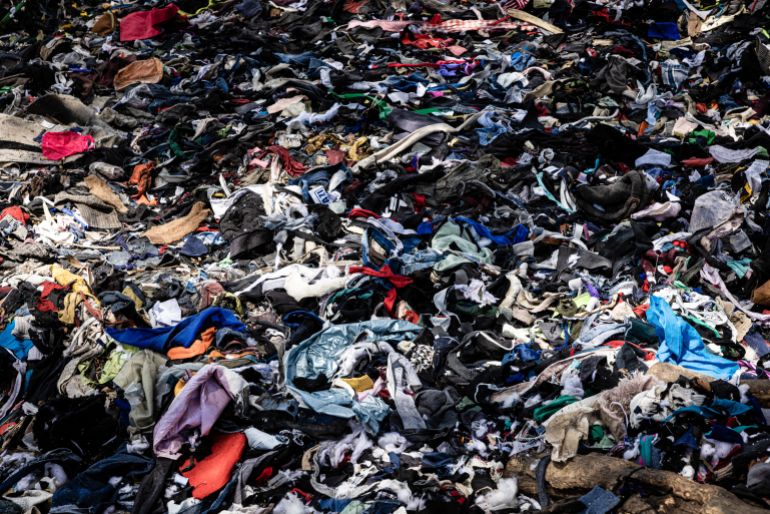
Mounds of unsold secondhand clothing that is damaged or worn-out is discarded on the shores of the Nairobi River outside Gikomba market. [Alyona Synenko/Al Jazeera]

Nicholas Kilonzi made his career at Gikomba. In 2009, his father died, and the family could not afford to pay for Kilonzi’s education. He found his first job helping a secondhand shoe merchant and eventually saved enough money to start his own business, which employs three people today.

Over the years, the quality of the clothes that come from abroad has gone down together with Kilonzi’s profit. “We open a 62kg [137lb] package, and we find maybe 10 cameras,” he said. “Five years ago, there would be 40 or 35.”

The non-cameras, clothes of poor quality, damaged or worn-out, are sold at 50 shillings ($0.35) a piece. The leftovers become industrial rugs or get discarded on the shores of the Nairobi River, which flows next to Gikomba. About one-third of all garments are plastic waste that will disintegrate into particles polluting the soil and the ocean.

Colourful mountains of unwanted clothing line the river’s shores – one of the consequences of the fast fashion industry. Such landscapes have become a familiar sight in the Global South, far from glamorous catwalks and glowing shop windows of the fashion capitals of the world.

To hold a mirror up to the industry’s environmental and social sins, the creative team behind Nairobi Fashion Week organised a photo shoot at the dump site. The shoot is part of its Just Fashion campaign, which runs from April to November.
Kenya fashion
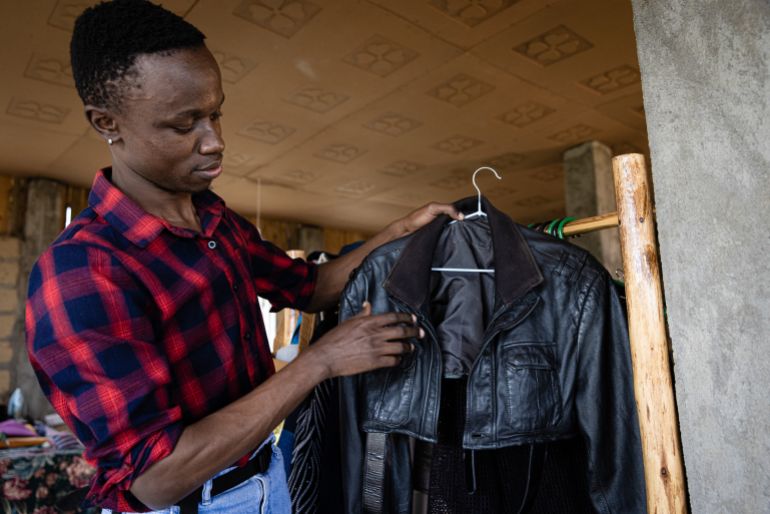
Conde Tausi, a designer from the Maisha by Nisria Collective, started making clothes from items in his mother’s closet that she no longer wore. [Alyona Synenko/Al Jazeera]

“We are not trying to fight the secondhand. It provides employment and affordable clothing to millions of people. We advocate for responsible consumer choices and government regulation policies to make fashion sustainable. What people buy makes a difference,” said Idah Garette, an environmental activist and model who participated in the shoot.

The organic silk dress with hand-painted sustainability messages that Idah wears on the campaign photos is a creation of Deepa Dosaja, one of Kenya’s high-end designers at the forefront of promoting ethical fashion choices. “I have seen a positive change,” Dosaja said. “People who used to shop in Dubai or London are now proud to wear Kenyan. Ethical fashion is not only better for the environment. It creates dignified and meaningful employment.”

Today, young designers are shaping Kenya’s fashion market and reinventing its long and conflicted relationship with the secondhand. Maisha by Nisria is a young fashion studio. Its designers, aged 21 to 28, create original pieces from secondhand garments and discarded fabrics. Shopping in places like Gikomba is part of their creative process and a way to reduce the environmental impact of their trade.

“You touch a piece, and it speaks to you,” says Conde Tausi, a 28-year-old designer for whom using secondhand started as a necessity and eventually turned into a purpose. “When I experimented with my first designs, I didn’t have money to buy fabrics. So I used things from my mother’s wardrobe – clothes she didn’t wear. After some time, I noticed the wardrobe became tidier. And I thought that maybe this is something we could do at the scale of the planet.”

Photos

Share this page

  • 𝕏 X/Twitter
  • 🔗 LinkedIn
  • 📘 Facebook
  • 💬 WhatsApp
  • ✉️ Email
Action News logo

Action News

A division of WestNet Continental Broadcasting

About

Part of WestNet N.A.

Action.News

Legal

  • Privacy Policy
  • Terms of Service
  • Action News Code of Ethics

Connect

  • Facebook.com/ActionNews
  • YouTube.com/@actionnew
  • Twitch.com/ActionNews
  • WhatsApp
  • Contact the Newsroom

© 2026 Action News™. All Rights Reserved.

Action News is a trademark of WestNet Continental Broadcasting. Other names may be trademarks of their respective owners.

🔴 LIVE
Action News Live ✖
🔊 Click to unmute