Home WebMail
| Calgary -1.1°C
Regions Advertise Login Contact
Action News Action News
  • World
    • Asia
    • Europe
    • Africa
    • Americas
  • Canada
  • US
  • Politics
  • Business
  • Technology
  • Entertainment
  • Sports
  • Breaking News
  • Latest Updates
  • Featured
  • Live
  • Live Now
  • UNICEF tells Al Jazeera what Gaza urgently needs but doesn’t have
  • Epstein files: Whose names and photos are in the latest document drop?
  • Can Alliance of Sahel States find a way to curb advance of armed groups?
  • Week in Pictures: From shooting in Australia to protest in Brussels
  • Israel kills two Palestinians, including 16 year-old, in West Bank
  • Manhunt under way in South Africa after mass shooting in Johannesburg
  • Palestinians attending wedding killed in Israeli attack on Gaza school
  • LIVE: Villarreal vs Barcelona – La Liga
  • Palestinian family left homeless after house collapses in storm-hit Gaza
  • Russia-Ukraine war may “grind on for another 12 to 18 months”
  • Thousands of candidates sit for government exam on airstrip in India
  • Algeria bill seeks to criminalise French colonial rule: What to know
  • Israel’s yellow line in Gaza has become a “site of killing”
  • LIVE: Israel continues ceasefire violations; 1 Palestinian killed in Gaza
  • Australia beat England to win third Test and retain Ashes
  • Jake Paul vs Anthony Joshua: Is this good for Boxing?
  • Sixty years ago, the world tried to stop racial discrimination and failed
  • Kylian Mbappe equals Ronaldo record in Real Madrid win over Sevilla
  • US seizes second oil tanker off Venezuela
  • Trump’s approach to Venezuela “ad hoc, unpredictable”
  • Australia honours Bondi Beach victims, launches probe of security services
  • Israeli death penalty bill violates international law: Palestinian analysts
  • Vigil in London for Palestinian prisoners held in Israel
  • ‘Slap in the face’: Epstein victims slam release of heavily-redacted files
  • South Africa shooting updates: At least 9 people killed near Johannesburg
  • UNICEF tells Al Jazeera what Gaza urgently needs but doesn’t have
  • Epstein files: Whose names and photos are in the latest document drop?
  • Can Alliance of Sahel States find a way to curb advance of armed groups?
  • Week in Pictures: From shooting in Australia to protest in Brussels
  • Israel kills two Palestinians, including 16 year-old, in West Bank
  • Manhunt under way in South Africa after mass shooting in Johannesburg
  • Palestinians attending wedding killed in Israeli attack on Gaza school
  • LIVE: Villarreal vs Barcelona – La Liga
  • Palestinian family left homeless after house collapses in storm-hit Gaza
  • Russia-Ukraine war may “grind on for another 12 to 18 months”
  • Thousands of candidates sit for government exam on airstrip in India
  • Algeria bill seeks to criminalise French colonial rule: What to know
  • Israel’s yellow line in Gaza has become a “site of killing”
  • LIVE: Israel continues ceasefire violations; 1 Palestinian killed in Gaza
  • Australia beat England to win third Test and retain Ashes
  • Jake Paul vs Anthony Joshua: Is this good for Boxing?
  • Sixty years ago, the world tried to stop racial discrimination and failed
  • Kylian Mbappe equals Ronaldo record in Real Madrid win over Sevilla
  • US seizes second oil tanker off Venezuela
  • Trump’s approach to Venezuela “ad hoc, unpredictable”
  • Australia honours Bondi Beach victims, launches probe of security services
  • Israeli death penalty bill violates international law: Palestinian analysts
  • Vigil in London for Palestinian prisoners held in Israel
  • ‘Slap in the face’: Epstein victims slam release of heavily-redacted files
  • South Africa shooting updates: At least 9 people killed near Johannesburg
Photos: Nigerians suffer along border with Niger as economic sanctions bite

Photos: Nigerians suffer along border with Niger as economic sanctions bite

The closure of Nigeria's border with Niger has worsened the economic situation and insecurity in the region.

By Al Jazeera Published 2024-02-26 03:05 Updated 2024-02-26 03:05 4 min read Source: Al Jazeera
Explained Human Rights Science & Technology In Pictures

Under the midday sun in northern Nigeria, three sisters trek across the border on their way to a wedding in Niger, carrying their babies on their backs.

The 1,600km (1,000-mile) frontier has officially been closed since August last year, when West African leaders imposed sanctions on Niger following a military coup that overthrew President Mohamed Bazoum.

The closure has taken a heavy toll on both sides.

In Nigeria, it has sharpened the effects of an economic crisis and exposed already vulnerable communities to an increase in violent crime. The hardship has been immense, hitting traders especially hard – but for many, the border is still porous.

The three women, who have family on either side, passed by the post at Jibia town in Nigeria freely on their way from northwestern Katsina state to Dan Issa village in Niger.

Authorities tend to turn a blind eye to pedestrians, and motorists have also found other routes to skirt round checks.

The women said the 800 naira ($0.50) fee for a motorbike taxi to their destination was too expensive.

“We can’t afford it, which is why we decided to trek,” said 30-year-old Saadatu Sani.

Women walk by the closed Niger-Nigeria border in Jibia [Kola Sulaimon/AFP]

Hit twice

Nigeria used to be one of Niger’s main trading partners, exporting $193m worth of goods to Niger in 2022, according to the United Nations, including electricity, tobacco and cement.

Niger’s exports to its neighbour totalled $67.84m in the same year, including cattle, fruit and refined fuel.

It is tougher for traders to cross the border, and they say the closure has had a severe effect.

Truck driver Hamza Lawal said his business had ground to a halt.

He said food had become so expensive people could “hardly eat three meals in a day”.

Locals say they have been struck by a double catastrophe, with food prices soaring since the border closure as well as reforms brought in by Nigeria’s new president which have plunged the country into a wider economic crisis.

After coming to office last year, President Bola Ahmed Tinubu ended a fuel subsidy and currency controls, leading to a tripling of petrol prices and a spike in living costs as the naira has slid against the dollar.

The country’s inflation rate reached almost 30 percent in January, according to the National Bureau of Statistics.

In Jibia, 100kg (220 pounds) of millet now costs about 60,000 naira ($40) – double the last year’s price.

Hassan Issa, Doctors Without Borders (known by its French initials MSF) coordinator in Katsina, fears malnutrition rates will reach new highs this year.

With Ramadan starting next month, he worries families in the predominantly Muslim state will “quickly exhaust their reserves during the festive period and find themselves with nothing very early in the year”.
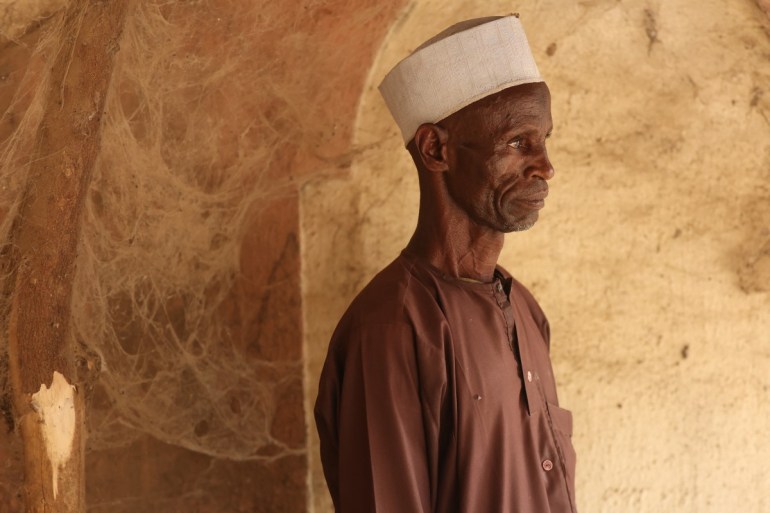
Musa Abdullah, 67, the head of the herders in Jibia [Kola Sulaimon/AFP]

Bribes and banditry

The border closure has also worsened insecurity in the region.

Over the years, old tensions between herders and farmers have morphed into a deadly conflict involving criminal gangs. Armed “bandit” groups kill, loot and terrorise the population.

They have stepped up attacks despite Nigerian military operations in the vast Rugu forest, one of their hideouts.

The conflict has driven farmers from their land, and bandits also steal livestock.

“We and the people of Niger are brethren, we are kith and kin,” said 67-year-old herder Musa Abdullahu.

“They bring these livestock to us to buy. Since the border is closed they cannot bring the livestock to us … and the local livestock have all been rustled by these evil people [bandits],” he said.

The economic fallout from the border closure has also led some Nigerians to turn to banditry.

“Poverty can lead to theft and murder … anything for survival,” said Jibia’s traditional leader Sade Rabiu.

But it is not just bandits that locals have to contend with.

Philip Ikita, project director for the Mercy Corps NGO in Katsina, said insecurity has risen since the closure thanks to the actions of “government security agencies as well as the bandits”.

At checkpoints along the road from Katsina city to Jibia, police, soldiers, local security groups, and self-appointed inspectors take money from road users.

Ikita said officials were stopping traders “not really to enforce the law but … to negotiate heavy bribes”.

“The bandits are underground, they can’t come out in the open,” he said. “The people that are supposed to enforce the law and protect us from bandits are the biggest burden to our free trade.”

Photos

Share this page

  • 𝕏 X/Twitter
  • 🔗 LinkedIn
  • 📘 Facebook
  • 💬 WhatsApp
  • ✉️ Email
Action News logo

Action News

A division of WestNet Continental Broadcasting

About

Part of WestNet N.A.

Action.News

Legal

  • Privacy Policy
  • Terms of Service
  • Action News Code of Ethics

Connect

  • Facebook.com/ActionNews
  • YouTube.com/@actionnew
  • Twitch.com/ActionNews
  • WhatsApp
  • Contact the Newsroom

© 2025 Action News™. All Rights Reserved.

Action News is a trademark of WestNet Continental Broadcasting. Other names may be trademarks of their respective owners.

🔴 LIVE
Action News Live ✖
🔊 Click to unmute