
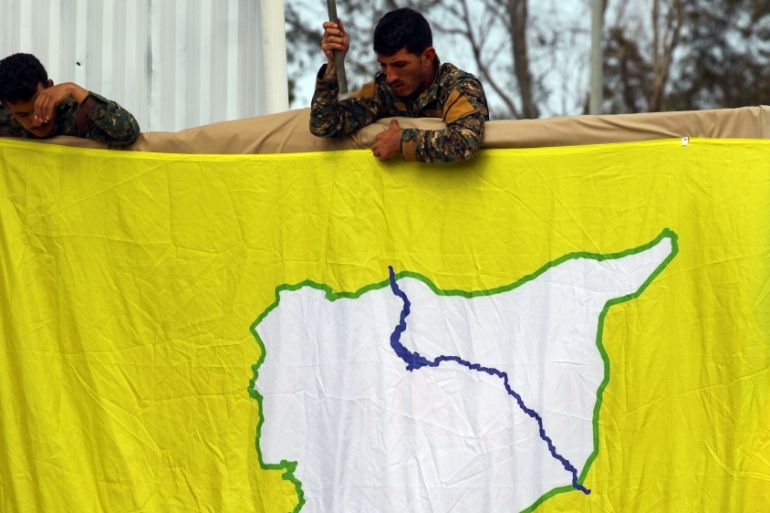
Renewed clashes erupted in Aleppo on Wednesday, displacing more than 45,000 people as the Syrian army declared two Kurdish-majority neighbourhoods “closed military zones”.
The fighting marks the fiercest escalation between the new Syrian government, led by President Ahmed al-Sharaa, and the Syrian Democratic Forces (SDF) since the fall of Bashar al-Assad in December 2024.
For years, the SDF was the West’s primary partner in the fight against ISIL (ISIS). But today, the group finds itself squeezed between a hostile Turkiye, a resurgent Syrian army and a stalled political deal to integrate into the new state.
So, who are the fighters at the centre of this struggle?
Who are the SDF fighters?
The SDF, an alliance of Kurdish and Arab militias, was founded in 2015, nearly four years after the initial armed rebellion erupted against the regime of Bashar al-Assad.
The group fights for self-rule in northeastern Syria, arguing that Kurds have historically faced systemic discrimination. Its makeup largely consists of the People’s Protection Units (YPG), supported by smaller groups of Arab, Turkmen, and Armenian fighters.
Turkiye considers the SDF an existential threat. Ankara views the YPG – the backbone of the SDF – as a “terrorist” extension of the Kurdistan Workers’ Party (PKK), which has waged an armed campaign inside Turkiye since 1984. The PKK is designated as a “terrorist group” by the United States and the European Union.
This tension has led to repeated conflicts. In October 2019, Turkiye launched “Operation Peace Spring”, a major cross-border offensive to remove SDF fighters from the border region and create a “safe zone”.
Prior to that, Turkiye launched two other operations: “Euphrates Shield” in 2016 to clear ISIL and YPG fighters from the northwest, and “Olive Branch” in 2018, which expelled the YPG from the Kurdish-majority city of Afrin.
What is the US connection?
The United States began arming the SDF in 2017 ahead of the offensive to recapture Raqqa, then the de facto capital of ISIL.
The SDF played the leading role in the ground war that dismantled the “caliphate”. However, the relationship has been volatile. The 2019 Turkish operation was precipitated by the Trump administration’s decision to withdraw American troops from the border, a move that left the SDF exposed and drew sharp criticism from US allies.
Today, the US still views the SDF as a partner in preventing an ISIL resurgence. Washington recently mediated talks between the SDF and the new Syrian government to integrate the force into state institutions, but those talks stalled this week, triggering the current violence in Aleppo.
The failed ‘March Deal’
The current fighting stems from the failure to implement the “March Deal“, an agreement reached in March 2025 following the change of government in Damascus.
Under the deal, the SDF agreed to merge “all civil and military institutions in northeastern Syria” – including border crossings and oil fields – into the new Syrian state.
However, Syrian Information Minister Hamza al-Mustafa told Al Jazeera on Wednesday that the SDF had violated the agreement “more than 100 times”, leading the army to declare the SDF-held districts of Sheikh Maqsoud and Ashrafieh in Aleppo as “military targets”.
Has the SDF violated human rights?
While the SDF promotes itself as a democratic force, it has faced accusations of rights abuses throughout the conflict.
The Turkish government has frequently accused the YPG of carrying out ethnic cleansing against Syrian Arabs. While a United Nations investigation in March 2017 cleared the group of ethnic cleansing charges, subsequent reports were more damning.
A March 2018 report by the UN Commission of Inquiry accused the SDF of conscripting children, including girls as young as 13, against their will.
“As part of forced conscription campaigns in areas under its control, the SDF continued to conscript men and children for military service,” the report stated.
More recently, the group has faced criticism over its management of the al-Hol camp, where thousands of families of suspected ISIL fighters have been held in conditions rights groups describe as inhumane.