
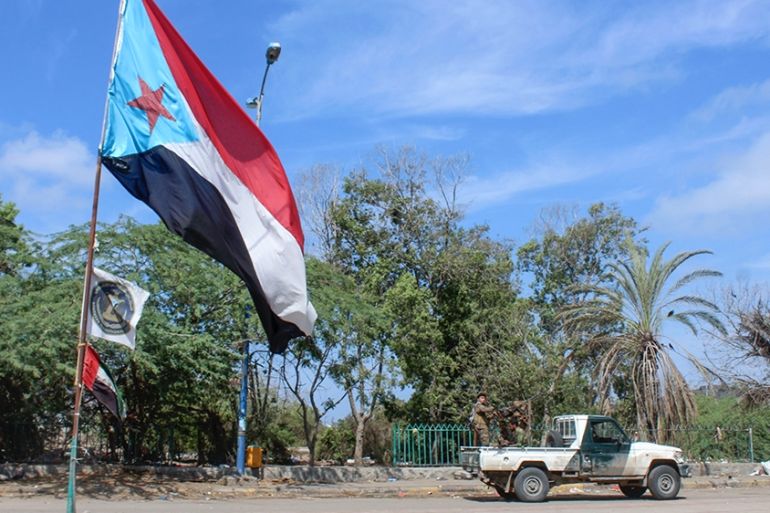
Yemen’s main southern separatists have accused Saudi Arabia of launching air attacks against their positions in Hadramout province, marking a sharp escalation in recent tensions between the group and its northern neighbour.
The Southern Transitional Council (STC) said on Friday that Saudi warplanes struck forces from the Hadhrami Elite twice in the Wadi Nahb area, first at 8am and again at 9:15am, while the separatist-affiliated Aden Independent Channel shared videos of the aftermath of the strikes.
Recommended Stories
list of 3 items- list 1 of 3Analysis: Yemen’s future after the separatist STC’s expansion eastwards
- list 2 of 3Yemen’s government, Houthis agree to exchange thousands of prisoners
- list 3 of 3Saudi Arabia demands Yemeni separatists leave seized governorates
Saudi Arabia has not confirmed carrying out any attacks.
There were no reports of casualties from the STC, but footage shared online and verified by Al Jazeera showed plumes of smoke rising near Wadi Nahb in a desert area, confirming that blasts had taken place.
The strikes came a day after Riyadh urged the STC to withdraw from Hadramout and al-Mahra, two eastern provinces the group seized earlier this month. On Friday, the group rejected Saudi Arabia’s call, saying it would continue securing the areas.
Friday’s strikes also followed clashes on Thursday between separatist forces and a tribal leader close to Saudi Arabia that killed two STC fighters, according to the group.
In a statement released hours after the air attacks, the STC accused Saudi Arabia of conducting “surprising aerial bombardment”, defending its move in the south.
“The Southern Armed Forces’ movement came in response to calls from our southern people to confront security threats represented by terrorist groups and to cut off supply and smuggling lines,” the STC said, adding it remained open to coordination that guarantees the security and unity of the south.
The separatists have pushed the Saudi-backed, internationally recognised government from large parts of southern Yemen this month, reviving the flag of South Yemen, which existed as an independent state from 1967 to 1990.
The rapid advance has given the STC control over nearly half of Yemen’s territory in the vast eastern regions, including oil-producing regions in Hadramout that border Saudi Arabia and Oman.
Heightened tensions
The STC offensive risks causing tension between close allies Saudi Arabia and the United Arab Emirates.
The UAE previously provided military and financial backing to the STC. On Friday, the Emirati Ministry of Foreign Affairs released a statement welcoming Saudi efforts to support security and stability in Yemen.
Both countries have sought to present a united front publicly, but their diverging interests on the ground could strain their coalition against the Houthis, who rule the country’s capital, Sanaa.
A joint Saudi-Emirati military delegation visited Aden earlier this month, asking the STC to return the seized territory, but the group refused, the AFP news agency reported, quoting sources close to the group.
Oman, which shares a border with the recently seized al-Mahra province and has served as a key mediator in Yemen, called on Friday for avoiding escalation and engaging in comprehensive political dialogue.
The renewed fighting has raised alarm at the United Nations, with Secretary-General Antonio Guterres warning last week that the STC advances risked wider escalation and further fragmentation. “A full resumption of hostilities could have serious ramifications on regional peace and security,” he said.
Competition for control
Mahjoob Zweiri, an academic and Gulf politics expert, told Al Jazeera that Yemen now faces a three-way competition for control between the Houthis in the north, the internationally recognised transitional government, and the STC.
“If the situation, the current status quo in and south of Yemen continues, Yemen will lose economically, will lose also politically,” Zweiri said.
Zweiri noted that only the transitional government led by Rashad al-Alimi has international recognition, while both the Houthis and the STC face legitimacy problems that will shape events in the coming weeks and months.
Yemen has been torn by civil war since 2014, when the Houthis seized the capital Sanaa and forced the government south. The Saudi-led coalition intervened in 2015, but years of war have killed hundreds of thousands and caused a major humanitarian crisis.
Fighting has eased since a UN-brokered truce in 2022, but separatist advances have “completely changed” the political landscape, Zweiri said.