


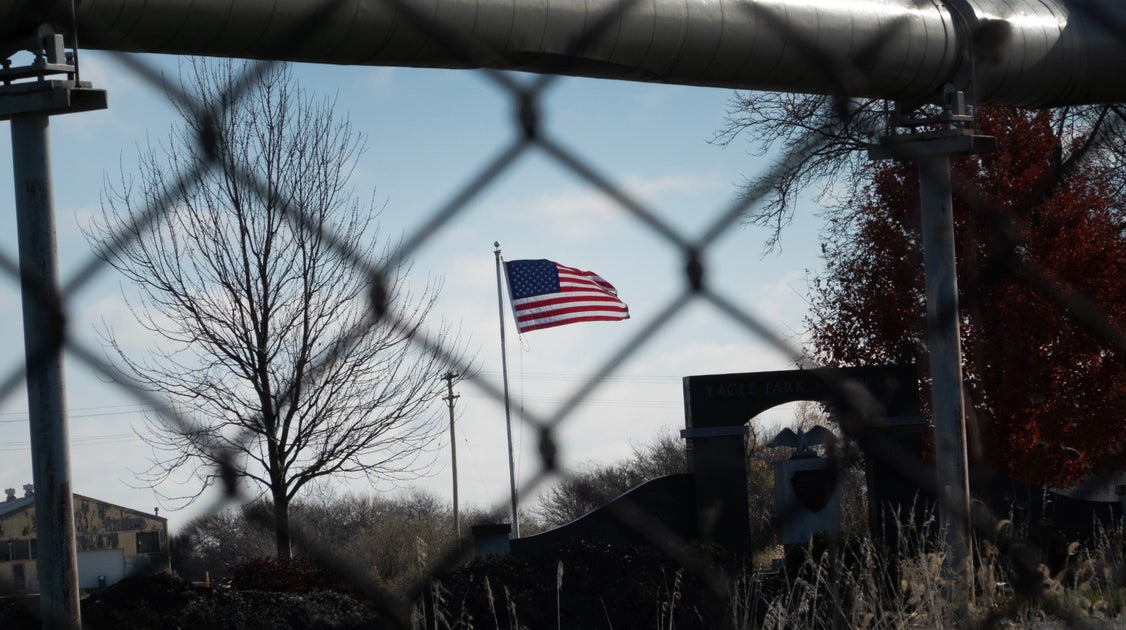
When the United States Army detonates a stockpile of lead azide in Middletown, Iowa, on Wednesday, the immediate danger will be the lead dust in the air. But the longer-term worry for residents is what’s left behind on the soil, water, outside homes and crops, and potentially livestock, where it could sit long after the evacuation orders are lifted.
The U.S. Army says the controlled blast is the only way for them to deal with about 9,700 pounds of lead azide that has degraded in storage “to protect the public from an uncontrolled, spontaneous explosion.” The detonation will likely happen around 9 a.m. CST, although the Army says it will decide on a more exact time after confirming the safest possible weather conditions.
Lead azide is a sensitive chemical explosive used in ammunition and other explosives, and once it degrades, it becomes highly dangerous and unstable. The Army projects the dust will settle across an area roughly 25 miles long and 5 miles wide, although it could travel much farther.
“The detonation is expected to produce a dust plume containing lead particles that may travel beyond the installation and settle on surrounding surfaces,” the Illinois Environmental Protection Agency said.
The plan has drawn significant pushback from residents and environmental groups concerned that the plume would spread toxic lead dust beyond what the Army projects. The health concerns include residents potentially inhaling lead-containing particles and touching surfaces where the dust lands.
“The safety of Iowans now and in the future should be the government’s top concern,” Rob Sand, the incoming Iowa governor, wrote on X. “An unacceptable lack of communication and clarity has made Iowans understandably concerned and angry about this situation. The public deserves to know, if this is the safest option, why other options were worse.”
What are the health risks?
Lead dust is invisible and odorless, and exposure often causes no obvious symptoms at first, especially in children. A blood test confirms it, according to the Centers for Disease Control. The dust can also settle on all kinds of objects, including food, water and clothes.
Children are especially vulnerable to lead exposure.
“No safe [blood lead level] in children has been identified,” the CDC states. “Even low levels of lead in blood have been shown to have an effect. Low levels of lead can reduce a child’s learning capacity, ability to pay attention and academic achievement. Some effects of exposure to lead can be permanent.”
Pregnant people and people at higher risk of cardiovascular disease are also more vulnerable, Thien Chau, an attorney at Earthjustice, told HuffPost. Earthjustice sued the EPA and Army on Nov. 19 to block the detonation plan.
Lead poisoning in livestock, pets and birds can also cause neurological disturbances, abnormalities, immunosuppression and infertility, according to the Merck Manual, and animals can be exposed to lead not just from the air, but from contaminated soil. Middletown is a small rural city that is surrounded by farmland.
The Army is asking people in the core of the projected plume to leave before the detonation, Kerri Johannsen, senior director of policy and programs at the Iowa Environmental Council, or IEC, told HuffPost. The Army has posted a map of the expected lead dispersion one hour, four hours and eight-plus hours after the detonation. According to its Public Safety Advisory issued Tuesday, designated safe shelters will be available through Friday.
Residents outside the evacuation zone are encouraged to shelter in place and stay indoors on Wednesday. It’s recommended to keep doors and windows closed for 24 hours after the detonation, use indoor air recirculation, limit unnecessary travel and wait until the Army determines both exposure threats have been eliminated.
Farmers and families should keep their pets and livestock away from the exposure area if possible, or at least keep them inside a barn or enclosed shelter, the Army said.
But the IEC argues residents need better tools, Johannsen said. As of Tuesday, residents are still waiting on more detailed maps so people can see exactly where the plume cloud is expected to fall relative to where they live.
“We need a better map as soon as possible so people know whether or not they’re in the detonation area,” Johannsen said.
There is a FEMA number residents can call, “but certainly I think people are used to interactive tools, and they would rather be able to have something that they can look at,” Johannsen said.
In a press release Tuesday, the Environmental Protection Agency said it is working with the Army, FEMA, the Department of Health and Human Services and other partners “to ensure the controlled detonation is conducted in the safest manner possible.”
“EPA has been on the ground conducting independent air, water, and soil sampling and will continue until the mission is complete. We are putting the full force of the agency behind this effort to ensure we are doing everything possible to protect human health and the environment,” Tom Croci, the EPA associate administrator for national security and operations coordination, said in the statement.
Health concerns are still relevant after detonation.
The IEC’s concerns extend beyond the blast itself.
“There could be and will be lead left behind on the property, the soil, the playground equipment, the exterior of people’s homes after this detonation,” Johannsen said.
While the Army has offered advice on keeping lead out of homes and cleaning it off, “It is just so unfortunate that we’re at the point that that is what people are now going to have to deal with,” Johannsen said.
Chau also warned that lead may not be the only concern.
“There are potentially other toxic contaminants that folks are worried about and still don’t have full information and transparency about,” he said. “People are concerned that they don’t know the full extent of what they’re being put at risk of.”
Chau said the Army should bear responsibility for cleanup and remediation after the detonation.
“The entity that is responsible for causing the risk itself should be responsible for all cleanup and all mitigation, all remediation necessary,” he said, adding that oversight agencies like the EPA should also have “a critical role to play.”
Johannsen said the Army and the EPA share responsibility for testing the air, soil, water and crops. The EPA has “the most expertise in this area of testing and what is safe,” she said. “This is their responsibility.”
“We expect a detonation to take place tomorrow, but that’s not the end of it,” Chau said. “We’re going to watch closely as to what happens after.”
Here’s why the Army says it has no other option.
In March, the Army said the material is very sensitive to friction, so physically moving it could trigger a massive explosion. According to its environmental assessment, the Army also considered and rejected chemically neutralizing the material, moving it to an on-site detonation facility and burying it.
Justice Department lawyers warned in a court filing that sub-freezing temperatures this winter could trigger an uncontrolled explosion.
“The real choice, in other words, is not between a detonation and no detonation,” the filing said. “It is between a planned and mitigated detonation and an unplanned and unmitigated explosion.”
An emergency permit from the EPA allows the Army to do the detonation between Nov. 13 and Feb. 11, 2027.
Chau said records that emerged during litigation show that the Army made “a series of choices” that eventually led to this decision. They include “continuing to store the lead azide in the first place for over 20 years, despite the fact that they don’t really use it anymore” and inspecting it “only periodically rather than more regularly,” he said. He also said the Army waited many months after recognizing the problem to try to treat the waste.
“The number of steps that were skipped, things that were missed along the way … This was neglect and mishandling,” Johannsen said. “It just shows a really big oversight here.”
While the Army has released more information about the site’s history during the lawsuit, Johannsen said, “We still definitely do not have all the answers, and that will be something that people in Iowa will be demanding.”