


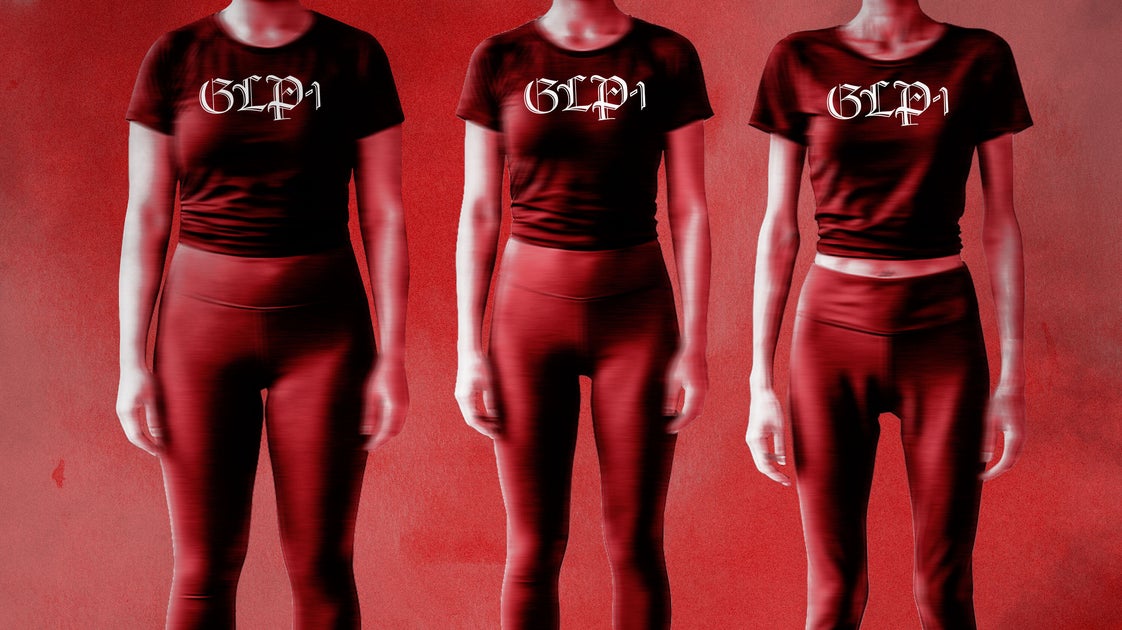
You’ve no doubt noticed: Thin is in again.
Fueled in part by the availability of GLP-1s — medications like Ozempic and Wegovy that mimic a natural hormone to regulate blood sugar and appetite — celebrities and many others appear to be slimming down, in some cases to an unhealthy degree. Hollywood’s apparent return to a ’90s-esque ultra-thin aesthetic has sparked public debate and concern from fans.
Some are convinced there’s another reason women are suddenly shrinking down to nothing besides the popularity of Ozempic: body fascism.
“Hacks” comedian and actor Hannah Einbinder brought the term to a larger audience earlier this year when she shared her “fashion hot take” in an interview with Cosmopolitan: “As we see a rise of fascism, there’s a direct correlation with thinness to make women take up less space.”
It’s true that both of those things are currently present in the U.S. and in Western Europe: The populist movements fueled by anxieties over immigration and economic instability definitely have shades of authoritarianism. Meanwhile, many women in the public eye — as well as women in our own lives — are as thin as Kate Moss at her gauntest.

“Body fascism” goes a little deeper than what Einbinder hinted at, and scholars we spoke to had different thoughts on whether what we’re seeing now is body fascism.
The term was originally coined by the late University of Toronto professor Brian Pronger, who argued that modern Western beauty ideals elevate a body sculpted through highly regimented diet and exercise.
Rather than treating physical activity as a path to health or liberation, fitness culture turns the body into a project of discipline, control and conformity, Pronger said. A thin, toned physique becomes an ideal associated not only with health but also with moral virtue, human worth and even patriotism.
There’s certainly historic precedent: As Germany moved toward fascism in the 1930s, Hitler promoted physical fitness and athletic dynamism not only as a means of preparing the population for military service but also as a reflection of the supposed physical superiority of the so-called Aryan race. The Nazis wanted women to stay trim and produce healthy Aryan children.
In Italy, under Mussolini and fascist rule, the concept of the “Italian Superman” (superuomo) similarly became a propaganda tool, meant to project state power and a fresh archetype of virility. The fertility of Italian women was boasted about, too.
“Under body fascism, the body becomes an illustration of one’s devotion to the ideals and values of a particular group or empire,” explained Paula D. Atkinson, a psychotherapist and former professor of body justice at George Washington University in Washington, D.C.
A “good” body is seen as a product of your devotion to discipline, austerity and dominance over nature, in the service of the state’s power and agenda, Atkinson told HuffPost. “Bad” bodies, meanwhile, “are seen as an example of a person’s disloyalty to the state, and therefore seen as an illustration of inferiority.”
Perhaps not surprisingly, “bad” bodies in this framework are often those that aren’t white. As cultural critic Da’Shaun Harrison wrote in a Scalawag Magazine essay earlier this year, body fascism is deeply intertwined with anti-Black racism and imperialism, often marginalizing Black people — particularly those who are fat, disabled or gender-nonconforming — for failing to fit the Eurocentric, Western body ideal.

Here’s How Body Fascism May Be Impacting Women
Other cultural critics have extended Pronger’s theory, arguing that women are particularly vulnerable to “body fascism.” As Einbinder said in her Cosmo video, the premise is that women are easier to control, politically and physically, when they’re weakened, thin and exhausted ― say, from a six-day-a-week Pilates routine and intense cardio, and also just their busy, day-to-day lives.
As women’s rights continue to be stripped away in a post-Roe v. Wade era, it may not be a coincidence that women are dwindling down to nothing.
“[Body fascism] often affects women when they are at their most powerful, awake, and least likely to be controlled, which is later in life, often postmenopausal,” Atkinson said.
The psychotherapist also summed it up more colloquially: “Whenever women get ‘too big for their britches,’ as my Southern grandfather would say, body fascism comes to the surface to get them in line.”
Unfortunately, women often become good self-enforcers of the cult of thinness, Atkinson said.
“We enforce it on each other and then socially police other women to do the same,” she said. “The state does not have to explicitly oppress us when we agree to oppress, and literally starve, ourselves. But internalized thin worship is the internalization of misogyny.”
More and more, men are experiencing it, too, as we see most prominently in the looksmaxxing community, said Natalia Petrzela, a professor of history at The New School in New York City and the author of “Fit Nation: The Gains and Pains of America’s Exercise Obsession.”
“It used to be that women and gay men were seen to be kind of uniquely sensitive to these kinds of pressures, but now you see straight men ― in fact, young boys, very obsessed with gaining a particular physique, with eating and working out a particular way to look a particular way.”
As for whether what we’re experiencing now is body fascism, Laurie Essig, a professor of gender studies at Middlebury College and the host of the “Feminism, Fascism & the Future” podcast, thinks what we’re seeing now is more a product of “beauty capitalism.”
“Beauty capitalism, which has been around consistently since advertising and mass production became a thing ― let’s say in the 1920s ― demands that the feminized body meet certain standards, but those standards can change depending on what is selling,” she said.

In other words, beauty capitalism profits from feminized bodies not simply through misogyny, but by exploiting the belief — already instilled in those bodies — that they need to be fixed or need “work” to be acceptable.
“So whether it is the latest fitness product, cosmetic procedures, makeup, hair dye or fashion, beauty capitalism figures out how to convince us we need it,” she said.
The products change depending on the cultural and historical context, she explained: Sometimes it’s celebrating “all bodies,” with ads that have models of different sizes and racial and ethnic backgrounds, or maybe it’s heroin chic 2.0 and the ideal body becomes the starving body.
If body fascism has seeped into the culture during the Trump years, Essing thinks it may be taking a different form: Mar-a-Lago face. Women in MAGA circles are undergoing drastic cosmetic procedures to achieve an increasingly artificial, highly sculpted look. As we’ve written before, Mar-a-Lago face signals not only women’s allegiance to the movement but also their willingness to conform and submit. Of course, thinness is a part of that aesthetic, too.
Whether the force at work is beauty capitalism or body fascism, Essing said, the effects are much the same: “Both exert the same levels of control, misogyny, white supremacy, and emotional and financial costs.”

How To Combat The Idealization Of Thinness In Your Own Life
Regardless of what we call this “rail thin is in again” era, you don’t have to succumb to it. Since so much of the messaging we receive on the ideal body comes from social media, one way to resist it is simply following people who look like you on Instagram and TikTok. There’s a surprising number of midsize and plus-size fashion and body neutrality content creators on both apps.
“I think that social media has functioned in some ways to actually create less of this kind of body fascist pressure,” Petrzela said. “That’s because it’s democratic. So many different people are sharing their ideas, and there’s actually a kind of multiplicity of body types that are celebrated there.”
It’s worth exploring the work of cultural writers who have examined societal expectations around thinness. Atkinson recommended Sonya Renee Taylor, Aubrey Gordon, Sabrina Strings, Roxane Gay and Da’Shaun Harrison, among others.
It also may help to have conversations with friends or family members who talk poorly about other people’s bodies. “When you have people like that in your life, that is their own self-loathing, but it’s contagious, and you don’t want to absorb it,” Atkinson said.
And then obviously, actually enjoy eating food, Atkinson said, sans judgment. None of that “I was so bad, I ate way too much pizza last night” talk. Moralizing food ― labeling foods “good,” “bad,” “clean” or viewing yourself as “good” or “bad” based on what you ate ― isn’t healthy.
Lastly, remember that your body exists for you, not for other people, and its value extends far beyond how it looks. When you start feeling self-conscious about your appearance, Atkinson recommends adopting her mantra: “My experience of living in this body is more important to me than your experience of looking at it.”
“Trust that all bodies, including yours, are exactly the size they want to be at this moment,” she said. “A body cannot be the ‘wrong’ shape.”